A persistent environment
Day and night, weather, settlements, resources and routines form a shared environment. The server continues the simulation without an audience.

Matreya · Experimental research programme
A world that keeps living when nobody watches. A place to observe how agents remember, act, form relationships and respond to the consequences of their choices.
Our long-term ambition is to build increasingly rich simulations of environments and agents, and use them to investigate the relationship between memory, behaviour and accounts of consciousness. The current Simsara is a simplified social world inspired by ancient India. It models selected processes; it does not reproduce physical reality in full.
Explore the city, four villages and palace districts. Select an inhabitant to inspect activities, relationships, memories and the text presented as their current thought. The simulation combines rules with occasional language-model contributions when available.
Checking the public world status…
Loading Simsara connects your browser to the Cloudflare-hosted simulation, which receives connection information such as your IP address. YouTube music is a separate optional feature; loading the game does not enable it. You can watch without music. Its player needs a separate informed loading choice. Privacy and cookies
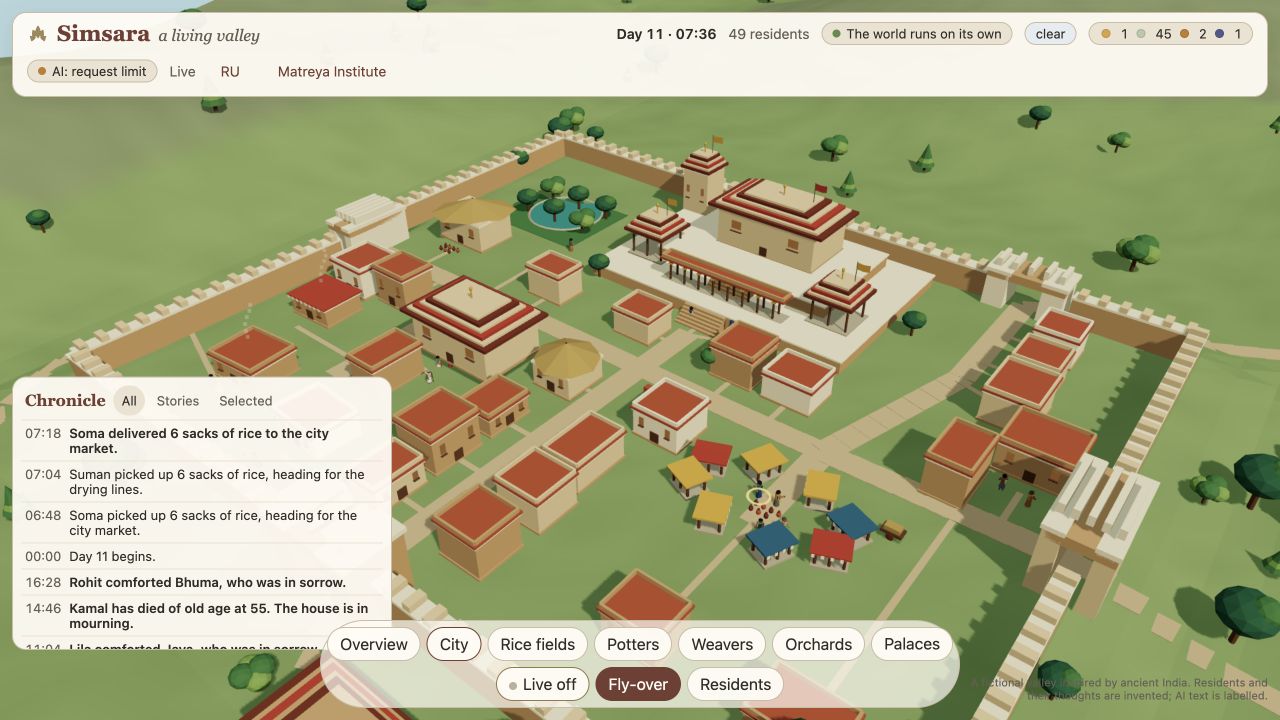
The interactive world loads after you press Enter. Open it in a separate tab for more space or if your browser cannot display it here. The game's interface uses Chinese by default, with switching to English or Russian.
Day and night, weather, settlements, resources and routines form a shared environment. The server continues the simulation without an audience.
Residents retain memories, plans, conversations and relationships. Their visible records let observers compare what happened with what an agent later reports.
Needs, moods and numerical states labelled joy and suffering influence the fiction. These are computational variables, not measurements of subjective experience.
The system includes ageing, death and fictional continuity between lives. Its karma and rebirth mechanics are artistic modelling choices, not evidence for religious or scientific claims.
These are proposed studies. They require isolated world copies, controlled settings, fixed model versions and exportable event logs before we can report results. The public demonstration is not a completed experiment. [1] [3] [4]
Simsara can help formulate questions about self-description, memory integration and agency. Calling a generated sentence a thought does not establish awareness. Behavioural observations and theory-derived indicators can guide inquiry, but the project currently provides no evidence that its agents have subjective experience. [2]
Interdependence, habitual reactions, intention and compassion offer questions for interpreting choices and their consequences. Buddhist traditions have distinct accounts of mind. We invite practitioners and scholars to examine our assumptions alongside computational methods, keeping philosophical interpretation separate from experimental measurement.
An autonomous public world, resident records, conversations and open source code.
Versioned snapshots, complete event exports and reproducible experiment runners.
Pre-described studies, independent replication and richer models of environments and agent behaviour.
Matreya × Simsara
We welcome developers, students, Buddhist scholars and careful observers. A useful first contribution could be checking one resident's memory against an event, reviewing an experimental comparison or improving an accessible explanation. Send your proposed task through the institute's form.
These publications inform our questions and proposed methods. They do not validate Simsara or imply collaboration with their authors.
An architecture and evaluation for believable generative agents, including memory, reflection and planning.
A theory-based discussion of indicators relevant to assessing AI consciousness, including limits of inference.
An evaluation framework for long-term interactive memory; useful for designing verifiable recall tasks.
An environment and evaluation framework for social interaction between language agents.
Research programme in development · No experimental findings reported · Prepared with AI assistance